Rethinking How Companies Work in the AI Era
Halil İbrahim Kalkan3 min read
Most of the tools we use to run our companies were designed for a world where only humans did the work. Now we're trying to integrate AI agents into those same tools and workflows.
I think we need to question this approach.
Companies have accumulated years of knowledge, documents, source code, business processes, and communication habits. All of this is usually spread across many different tools.
This was already a problem before AI. But now that we expect AI agents to do actual work, not just answer questions, having all this context scattered across different systems becomes an even bigger problem.
An AI agent needs to understand what it's working on, why something needs to be done, what decisions have already been made, and where to find relevant information. It also needs to communicate with people, participate in discussions, use tools, and collaborate with other agents.
Simply adding AI features to existing tools doesn't fully address these needs.
What if we designed everything from scratch?
At Volosoft, we started asking ourselves this question.
We reviewed our internal processes, the tools we use, how we manage projects, how we communicate, and how we share knowledge. We also tried to understand the needs of our customers and other companies.
Instead of asking how to integrate AI agents into our existing workflows, we asked how we would design those workflows if AI agents were part of the team from the beginning.
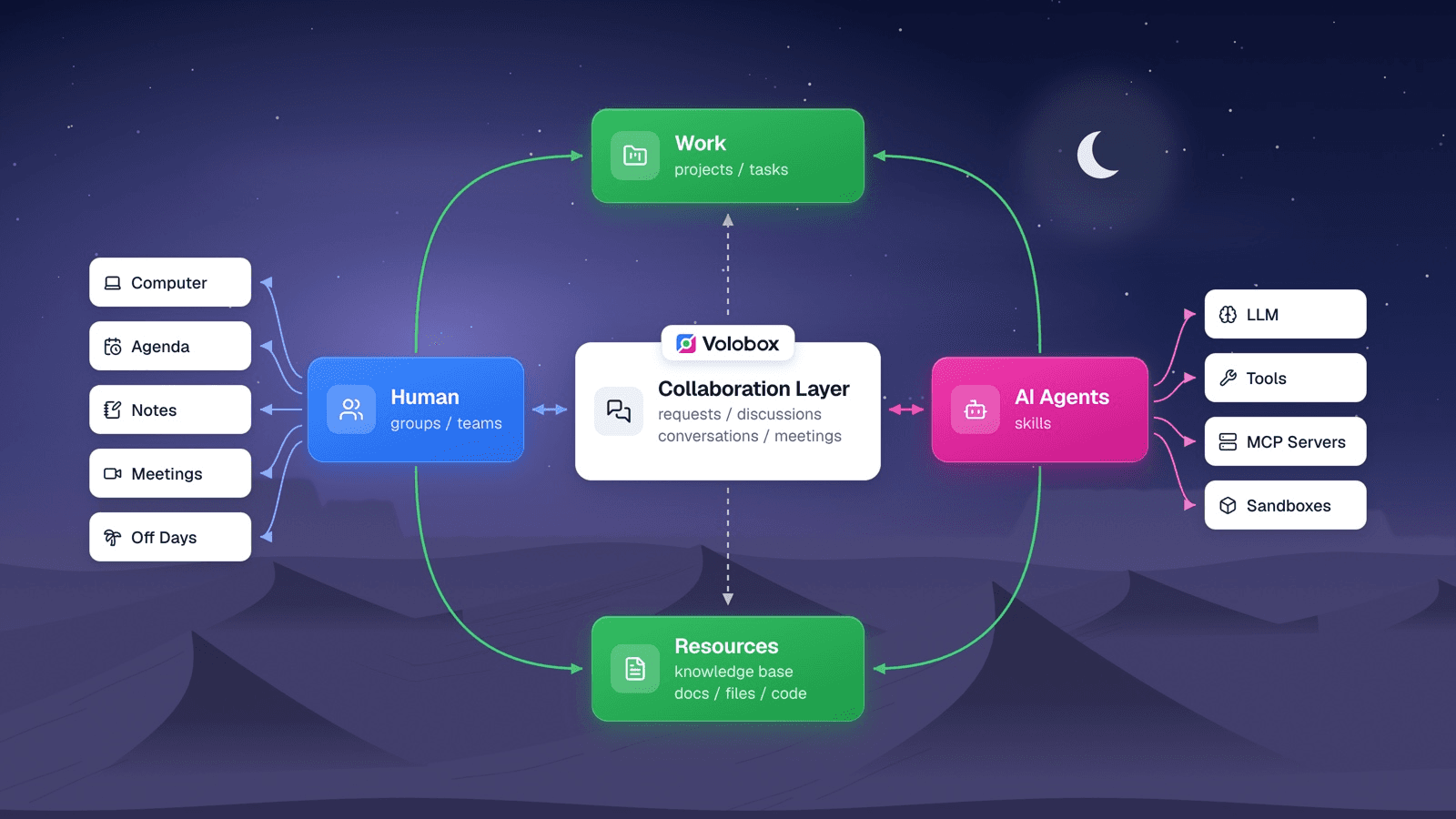
The diagram above summarizes our thinking.
We see four main parts:
- Humans: Employees, teams, and departments, with their own schedules, meetings, notes, and personal work environments.
- AI Agents: Agents with different skills and capabilities, using LLMs, tools, MCP servers, and execution environments to perform actual work.
- Work and Resources: Projects, tasks, documents, knowledge bases, files, and source code that both humans and agents need to access.
- Collaboration: A shared environment where people and agents can communicate, discuss problems, make decisions, and coordinate their work.
The important part is how these pieces connect.
We don't think AI agents should operate in isolated chat windows, disconnected from the people and projects they're supposed to help.
They should be able to participate in the same work, use the same relevant context, and collaborate with people as part of the team.
Of course, humans and agents have different capabilities and need different tools. But they should be working within the same environment, with appropriate permissions and controls.
From an idea to a real product
This thinking eventually led us to build Volobox.
We designed it as a flexible workspace that could support different types of companies, not just software development teams.
But before offering it to others, we started using it ourselves.
We've been running our daily work on Volobox for several months now, continuously improving it based on our own experience. It has already made a significant difference in how we work.
Last week, we made Volobox generally available.
We've demonstrated it to many companies so far, and some have already started their trials. The initial reactions have been very encouraging.
There's still a lot to improve, and I'm sure our understanding of how humans and AI agents should work together will continue to evolve.
But one thing I'm increasingly convinced of is that the AI era requires more than adding AI features to existing business software. We need to rethink how our companies actually work.
That's what we're trying to do with Volobox.
If you're interested in exploring this approach, you can learn more and book a free demo at https://volobox.io/demo